
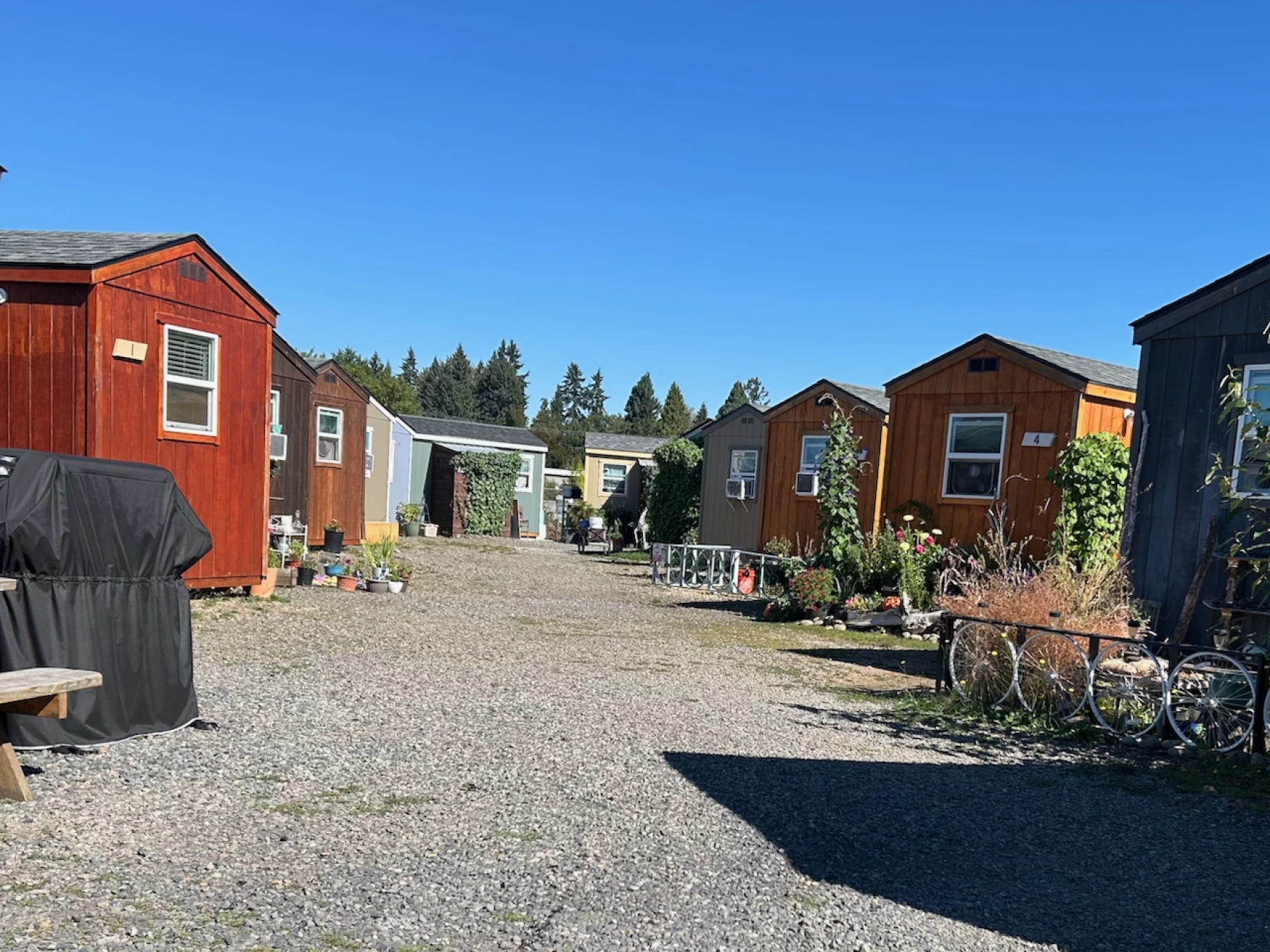
A nearly $2.5 million federal grant will help launch a pilot program in Eugene aimed at creating low-cost permanent housing for people who have experienced homelessness.
The project is a partnership between Opportunity Village, Lane Workforce Partnership and several other local groups.
Gabe Piechowicz, founder and executive director of Everyone Village, said the current model of tiny homes is intended to be transitional. But high rents have made it difficult for residents to move into traditional housing.
“So we get folks restabilized, health regained, hope restored, ready to go out and be amazing members in the community, stand on their own two feet, and there’s nowhere they can go that they can actually afford,” Piechowicz said.
100 Micro-Homes Planned
The pilot will create 100 micro-housing units for people earning less than 30% of the Eugene area’s adjusted median income — currently $19,250 annually for a one-person household, with the threshold adjusted each year.
Monthly rent will be set at $300.
High school students will build the homes through a Lane Workforce Partnership construction training program.
“For students who participate in the program, they’re getting hands-on experience within the construction trades. No longer are they building bird houses but they’re building real houses for families impacted with homelessness,” said Jesse Quinn of Lane Workforce Partnership. “Industry also benefits because they get a new pool of talent entering the workforce beyond graduation.”
The first phase of the micro-village will be located on property adjacent to Everyone Village. Each unit will measure roughly 16 by 16 feet and include a bathroom. Residents will share kitchen and laundry facilities and have access to on-site medical and social services similar to those currently offered.
Federal Support and Next Steps
The $2.465 million in federal funding was championed by U.S. Sens. Ron Wyden and Jeff Merkley.
Piechowicz said the project brings together students, colleges, nonprofit partners and residents themselves in a collaborative approach to housing solutions.
Planning and review processes are underway in coordination with the City of Eugene. Piechowicz estimates the first home could be ready for move-in sometime in 2027.
Additional partners include PeaceHealth, Lane Education Service District and the City of Eugene.
Organizers hope the micro-village model can eventually be replicated in other Oregon communities.










Leave a Comment