
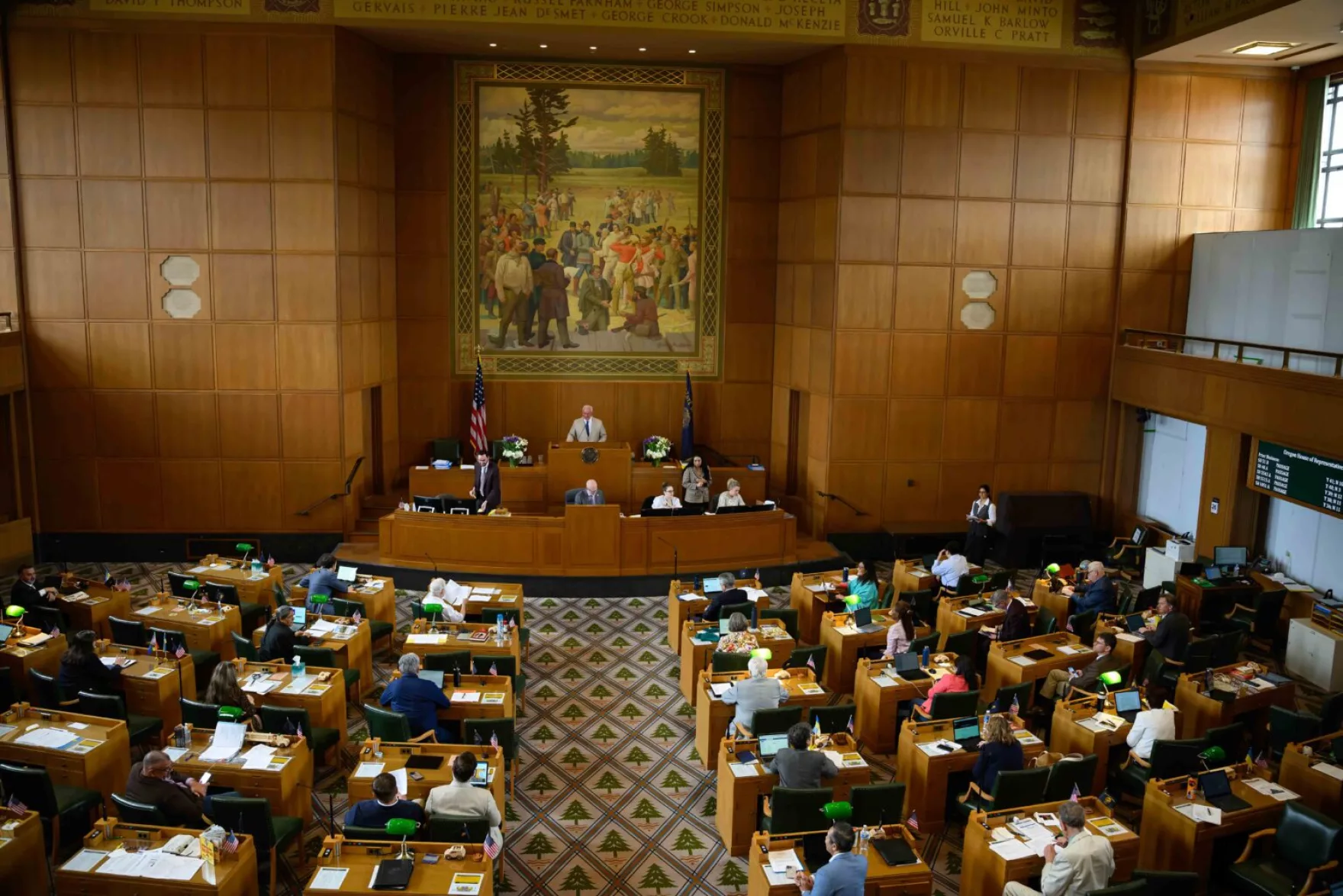
Most Democrats in the Oregon House of Representatives voted to partially disconnect Oregon’s tax code from recent changes to the federal tax code, a move aimed at preserving hundreds of millions of dollars in state revenue. Republicans, in response, signaled they may refer the measure to voters in November.
Lawmakers passed Senate Bill 1507 on a 34-21 party-line vote, selectively removing two federal business tax cuts and one tax break on auto loan interest from applying to state taxes. Oregon is among a small number of states that automatically conform to federal tax code changes unless lawmakers act to decouple specific provisions.
The bill previously cleared the Oregon State Senate in a 17-13 party-line vote and now heads to Gov. Tina Kotek, who is expected to sign it.
Rep. Ed Diehl, R-Scio, said Republicans plan to pursue a ballot referral to overturn the changes. To qualify the measure, opponents would need to gather 78,116 signatures — equal to 4% of the votes cast in the most recent gubernatorial election — within 90 days after the Legislature adjourns.
Supporters say the bill will preserve a net $291 million in tax revenue over the next 18 months that would otherwise be lost if Oregon fully adopted the new federal tax cuts. The measure also establishes new state-level tax credits for businesses that expand in-state hiring and for low- and moderate-income residents.
“These straightforward policies protect funding for schools, health care and community-based services, while allowing us to lower taxes for working families and support jobs,” said bill sponsor Rep. Nancy Nathanson, D-Eugene.
Republicans argued the state should instead reduce spending and maintain alignment with federal tax changes. Rep. Mark Owens, R-Crane, said removing the federal bonus depreciation provision — which allows businesses to immediately deduct 100% of equipment purchases — would hurt family farmers and small businesses.
Under the bill, Oregon will continue to align with certain federal changes, including ending income taxes on overtime pay and tips and allowing deductions for research and development costs. However, it will not adopt the federal provision allowing full, immediate deductions for new equipment purchases. Instead, businesses will deduct those costs over time, as previously required, preserving about $267 million in revenue over the next 18 months.
The state will also reject the new federal deduction for auto loan interest on new vehicles, preserving an estimated $36 million, and disconnect from the federal Qualified Small Business Stock Exemption, preserving roughly $39 million.
In total, the selective disconnections are expected to retain about $342 million in revenue during the next 18 months.
The bill directs $25 million of that preserved revenue to a new state tax credit for businesses that create jobs in Oregon and pay at least 150% of the state’s minimum wage — or about $22.58 per hour. Eligible businesses could receive a $1,000 credit per new employee, for up to 10 hires per tax year.
Another $26 million will fund a 5-percentage-point increase to Oregon’s Earned Income Tax Credit for low- and moderate-income residents. Individuals and families earning less than $68,675 could qualify for a credit worth up to 17% of their earnings, depending on income and household size.
In 2023, more than 212,000 Oregon taxpayers — about 11% of filers — claimed the state’s earned income tax credit, receiving an average benefit of $222, according to state data.











Leave a Comment