

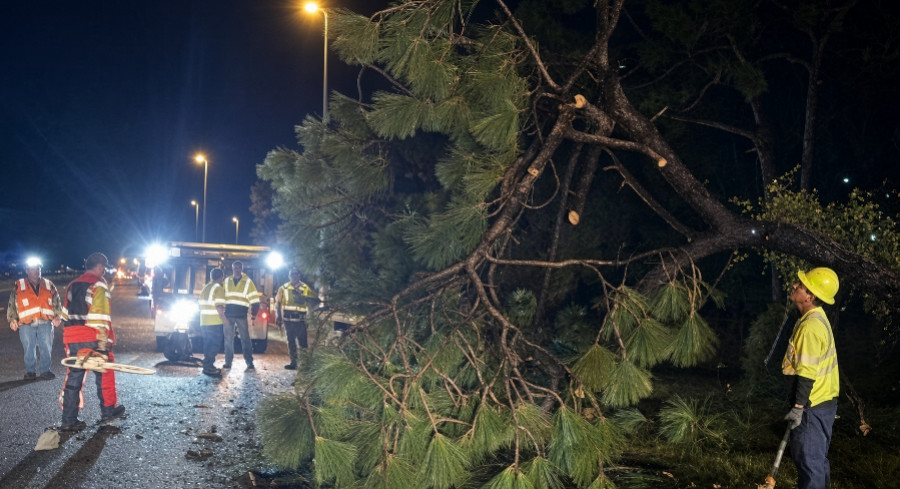
Florida emergency officials and utility crews kicked off a massive recovery effort across the Panhandle on Saturday after Hurricane Isaias slammed into the coast as a Category 2 storm, knocking out power for nearly 450,000 customers, toppling trees, and flooding coastal roads.
Governor Ron DeSantis, alongside Attorney General James Uthmeier and Division of Emergency Management Executive Director Jared Perdue, gathered at the State Emergency Operations Center in Tallahassee to outline the state’s coordinated response. DeSantis signed Executive Order 26‑202, updating EO‑26‑212 to declare a state of emergency in 27 Florida counties.
Isaias touched down near Destin at about 9:30 p.m. EDT on Friday, bringing sustained winds of 105 mph. Gusts peaked at 116 mph near Santa Rosa Sound and 100 mph near Pensacola, while a coastal storm surge lifted water levels in Panama City Beach roughly 5.6 feet above the normal high tide. After moving north through the western Panhandle into southern Alabama, the system weakened into a post‑tropical cyclone early Saturday morning.
Utility companies had already positioned more than 16,000 linemen and restoration specialists ahead of the outer bands. Still, the storm knocked out service to about 448,298 customer accounts statewide by 7 a.m. Saturday, prompting crews to work around the clock to restore power in the hardest‑hit areas.
Clearing blocked arteries became the top priority at first light. Over 1,100 Florida Department of Transportation workers and 260 heavy‑machinery units sprang into action to remove downed trees and debris. Forty cut‑and‑toss crews cleared Interstate 10 before 6 a.m., allowing all interstate routes to reopen. U.S. 98 and every state‑owned coastal bridge were also cleared and reopened to traffic by 6 a.m. after safety inspections.
To keep evacuees and emergency convoys moving freely, DeSantis waived tolls on the Mid‑Bay Bridge and Spence Parkway in Okaloosa County, as well as the Garcon Point Bridge in Santa Rosa County.
State military and law‑enforcement personnel mobilized in large numbers across the affected corridor. About 5,000 soldiers and airmen from the Florida National Guard were activated, bringing more than 1,300 high‑wheeled vehicles, 10 Zodiac boats, 50 route‑clearance vehicles, and eight helicopters. Five additional helicopters from Tennessee and Mississippi stood by through the Emergency Management Assistance Compact.
The Florida State Guard deployed nearly 400 soldiers to conduct search‑and‑rescue missions, operate supply distribution points, and clear blocked roads in Escambia and Holmes counties. The Florida Fish and Wildlife Conservation Commission added airboats, shallow‑draft vessels, and high‑water vehicles to assist stranded residents.
While the main highways reopened quickly, local travel hubs faced disruptions. Commercial passenger operations remained closed Saturday at Pensacola International Airport and Destin‑Fort Walton Beach Airport, whereas Northwest Florida Beaches International Airport in Panama City reopened. Maritime operations at both the Port of Pensacola and Port Panama City stayed halted.
Healthcare and community facilities also felt the impact. The Agency for Health Care Administration recorded six facility evacuations across the 27 emergency counties, involving four assisted‑living facilities, one nursing home, and one hospital. Nine Panhandle counties kept special‑needs shelters open, and the Florida Department of Health placed its central warehouse on 24/7 duty to supply clinics and local responders.
The Florida Department of Children and Families staged 600 pallets of food, hot‑meal distribution, and crisis‑counseling teams in storm‑damaged towns. Private partners stepped in, too: Uber offered free round‑trip rides up to $40 each way to state‑approved shelters with the promo code ISAIAS26, and Comcast activated more than 26,000 free public Xfinity Wi‑Fi hotspots across the region.
State officials urge residents returning home to steer clear of downed lines and flooded streets. Real‑time road closures are available through the FL511 system, and general recovery resources can be accessed at FloridaDisaster.org.



Leave a Reply