

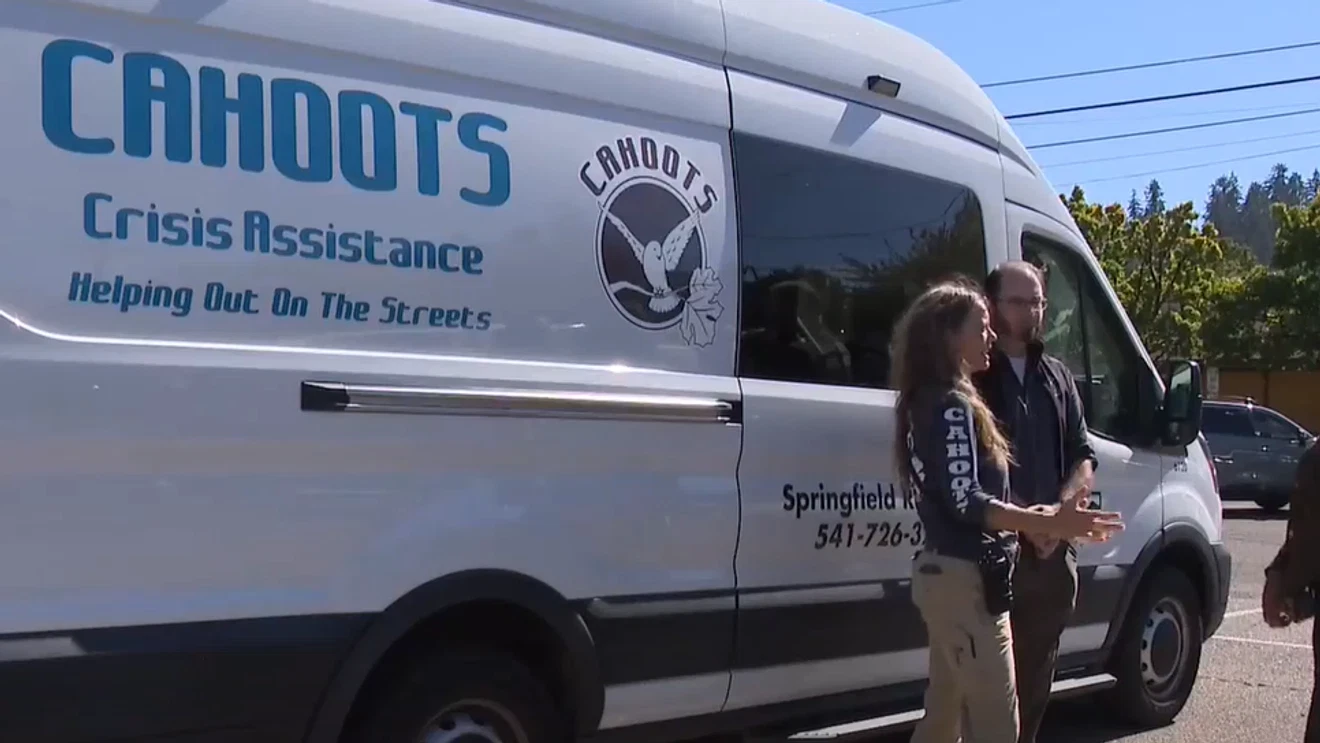
A year after CAHOOTS ended its mobile crisis services in Eugene, the city has chosen a partner to lead a new peer navigation program.
Eugene officials announced Monday that they selected Ideal Option for a one-year pilot program aimed at filling gaps in services once handled by CAHOOTS, including welfare checks and non-emergency transportation.
Ideal Option already collaborates with Lane County’s jail deflection program. In January, the company also partnered with the Eugene Police Department to provide peer navigators in the downtown area.
Under the new program, outreach workers will also serve other high-need areas such as the Whiteaker, Highway 99, and west Eugene.
Eugene-Springfield Fire Chief Mike Caven said the navigators will focus on individuals who are not in immediate crisis but are dealing with homelessness or addiction and need help accessing services.
“It is ‘What’s got you here? How come somebody felt it necessary to call 911 for you?’” Caven told KLCC. “‘Let’s get you your ID so you can get to health care, so you can get to some type of treatment situation.’”
Caven said the navigators will follow up with clients to ensure the services they received were appropriate. He added that, unlike the downtown program, these workers will be integrated into the 911 dispatch system.
According to Caven, the program is expected to launch within two months. While the exact hours are still being finalized, officials are considering operating during peak times from late morning through early evening.
“Our goal with this is to start to target those most vulnerable,” said Caven, “and get the feedback from the field and see what is needed in a potential next phase.”
Competition
Officials selected Ideal Option’s proposal over one submitted by Willamette Valley Crisis Care, a nonprofit led by former White Bird Clinic employees who have said they aim to recreate CAHOOTS-like services.
In an emailed statement Wednesday, WVCC said its leadership felt disappointed but not surprised. The group said its proposal would have delivered crisis response services seven days a week, along with follow-up care and case management.
“The city prioritized a law enforcement-based deflection service that we hope can meet important community needs,” the nonprofit wrote. “At WVCC, we are regrouping and preparing to vision a new role in the community safety ecosystem.”
Caven said the city considered the fact that Eugene now has Lane County’s mobile crisis services, which can respond to people in acute distress in ways CAHOOTS previously did.
“Willamette Valley Crisis Care put forward a very thoughtful proposal anchored in how the system used to operate,” said Caven. “When you score a Request for Proposal, it’s based on specifically what you’re asking for.”
Jacob Trewe, volunteer coordinator for Friends of Alternative Response, said the decision saddened him. He said Ideal Option’s model is highly location-based and does not offer basic medical services.
“If folks are expecting CAHOOTS-style service to resume here in Eugene, they will not be seeing that in the immediate future,” he said.
Trewe added that advocates continue to push for a full return of services.
“Hopefully, the city will recognize that the need that they identified in the gaps analysis is still there,” he said, “and they will move forward with some other project to be able to address the needs of the community.”
Ideal Option said its Director of Community Development was not immediately available for an interview.







Leave a Reply