

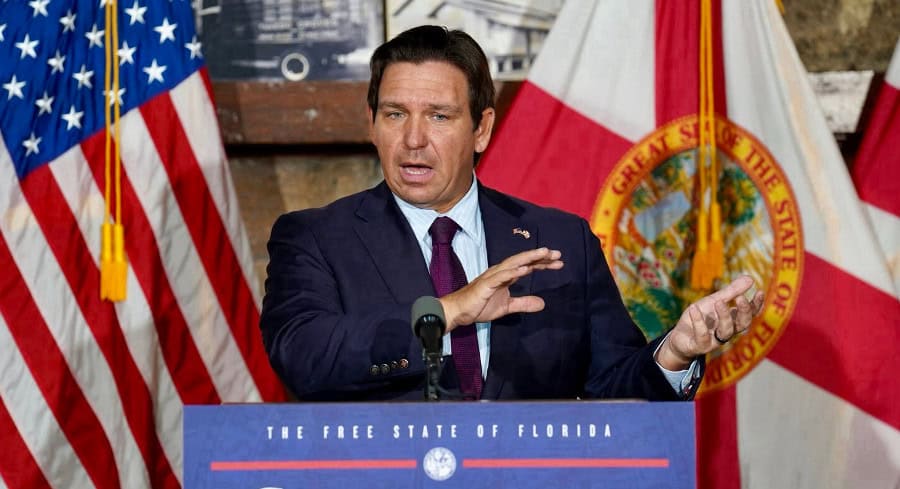
Florida Governor Ron DeSantis wasted no time delivering a scathing political assessment following the 2026 midterm elections, directing sharp and unambiguous criticism at the Republican establishment in Washington before his tenure as governor concludes.
After a devastating midterm cycle that saw Republicans lose significant ground across the country and surrender historically reliable strongholds such as Texas, DeSantis addressed the Republican Party’s collapse on Wednesday. He argued forcefully that the results did not represent a national embrace of liberal ideology, but rather a decisive rejection of a disconnected and self-serving Republican leadership class operating inside the Beltway.
“This is close to an extinction-level event for Republicans in many parts of the country as we have seen probably in the last hundred years,” DeSantis said bluntly. “We knew it could be worse, but I don’t think most of us thought it would be quite this bad… this is probably the political worst-case scenario for a midterm election.”
DeSantis cautioned that the consequences of this electoral collapse would extend well beyond a single difficult election cycle, effectively locking the Republican Party out of power in Washington for the foreseeable future.
“So this is really going to have an impact two years, four years, six years, maybe even longer before Republicans could exercise unified control in Washington again like we’ve enjoyed over the last two years,” he warned.
The governor attributed the party’s collapse directly to economic hardship facing working families, arguing that congressional Republicans remained willfully blind to the financial pressures ordinary Americans endure daily.
“Mortgage rates are over 7%. Gas is $4 a gallon. Grocery prices have gone up and all these,” DeSantis said. “And so, I think it was more kitchen table issues and bread and butter issues than that.”
He directed equally pointed criticism at the party’s ethical failures and broken commitments, specifically calling out lawmakers who blocked transparency surrounding the Jeffrey Epstein files and who accumulated personal wealth through financial market activity while simultaneously crafting federal legislation.
“We ran as Republicans on saying we need to do that. And then you actually have people in the Congress voting against release when the Attorney General said she had all this horrific stuff on her desk and that people were gonna be held accountable,” DeSantis said.
He continued, challenging the implausible financial gains observed among elected officials: “My view was, how do you have no investment acumen and then all of a sudden get elected to Congress and then you’re outperforming Warren Buffett? How does that work?”
Turning his attention to the quality of Republican candidates fielded during the cycle, DeSantis offered no charitable assessment.
“They didn’t have a great positive case for themselves. They were flatfooted,” he said. “They were trying to explain this or explain that in ways that weren’t landing with voters.”
His pointed remarks immediately generated significant attention across financial and political circles, sending noticeable movement through political prediction markets tracking the 2028 presidential race.
On Kalshi, Vice President JD Vance experienced an immediate decline in his standing as the presumptive frontrunner for the 2028 Republican presidential nomination. His projected probability of securing the nomination dropped from 35% on Tuesday to 27% on Wednesday. During that same 24-hour window, DeSantis saw his odds triple, rising from 5% to 17%, as market participants rewarded his willingness to publicly challenge party leadership.
Across broader prediction markets, Vance maintained a narrowed lead at 31%, with contract shares priced at 31 cents. U.S. Senator Marco Rubio placed second at 22% to 23%, trading at 23 cents per share, while DeSantis climbed swiftly into third position at 18% to 19%, trading at 18 cents per share. Driven by substantial post-election trading activity, nomination contract volume reached $78,112,958 on Wednesday alone.
The surge in betting activity coincided with DeSantis’s appearance on SiriusXM’s “Straight Shooter with Stephen A.” on the P.O.T.U.S. channel, during which the term-limited governor declined to rule out future political ambitions.
When asked directly by Stephen A. Smith whether another presidential campaign was under consideration, DeSantis remained deliberately noncommittal.
“We’ll see what happens. Maybe someday. I don’t know about ’28, maybe later, maybe. We’ll see,” DeSantis said.
Smith pressed the governor further on what he intended to do once he formally departed the governorship in January.
“Old governors never die, they just fade away, right? So we’ll see what happens,” DeSantis replied.
His warnings directed at the Trump administration, however, carried no such levity. Addressing the ongoing confrontation with Iran, DeSantis argued that the White House’s foreign policy entanglements are directly contributing to elevated fuel prices and positioning the Republican Party for further electoral damage.
“Gas is higher. It hurts people, working class people, and it’s higher because of this conflict. That’s just a fact,” DeSantis said. “If you can’t admit that to voters, then you’re gaslighting them and they’re not going to listen to you on other things.”
He further cautioned that prolonging the conflict would severely constrain the administration’s domestic agenda: “It’s going to be devastating to his ability to get anything done and it is going to be very, very difficult for Republicans.”
DeSantis also renewed his call for an outright ban on congressional stock trading, condemning the culture of self-enrichment that he argued defines Washington today: “This swamp here is the worst it’s ever been. How are we not banning the congressional stock trading?”
Despite the severity of his diagnosis, DeSantis maintained that the Republican Party retains a path toward recovery, pointing to the political coalition he constructed in Florida as the blueprint for rebuilding national relevance.
“Now it’s going to take a lot of time and effort to rebuild. It will not happen in just one election cycle,” DeSantis said. “But Florida shows how you can build a coalition.”



Leave a Reply