

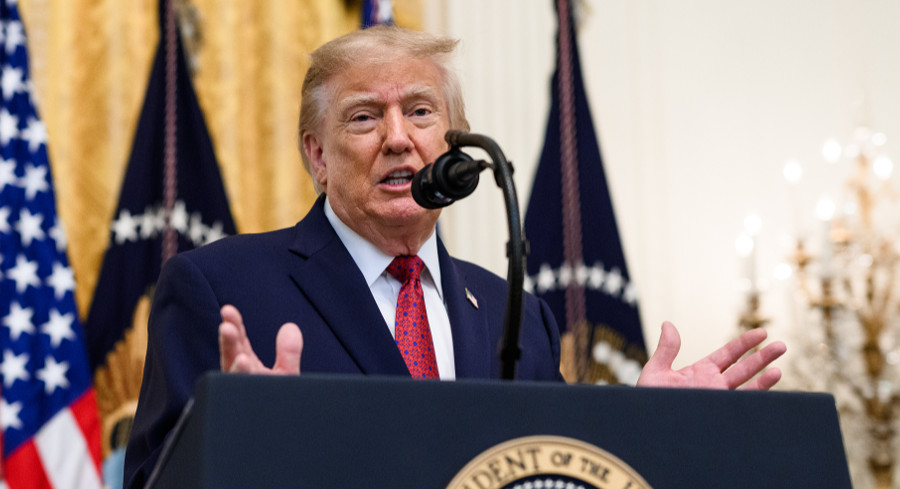
The day after voters returned Democrats to power on Capitol Hill, President Donald Trump reaffirmed his administration’s military campaign in Iran, dismissing visible dissent from his own vice president and maintaining that he would authorize the strikes again under the same circumstances.
Speaking to reporters at a White House event centered on planned ballroom renovations, Trump argued that military intervention represented the only viable course of action to prevent Tehran from acquiring nuclear weapons.
“We stopped them from having a nuclear weapon, and they will never have a nuclear weapon,” Trump stated.
Trump acknowledged widespread public frustration over the economic consequences tied to the ongoing military offensive, drawing a deliberate distinction between the conflict itself and the financial hardship experienced domestically: “the price, not the war, the price.”
His defense stood in direct contrast to a candid assessment delivered hours earlier by Vice President JD Vance. In a public post on X, Vance explicitly attributed the Republican Party’s loss of congressional majorities to the overseas military operation.
“The reason we lost is the war,” Vance wrote. “The president himself said so last night. If you’d like to argue it was worth it, that losing the Senate for the next 6 years was worth it, then do so. Argue it was a worthwhile cost to pay.”
The internal division became fully public as election results delivered Democratic control of both the House and Senate, though closely contested races in Mississippi and Alaska remained without formal calls through Wednesday afternoon. The immediate political fallout within Republican ranks proved swift, with House Speaker Mike Johnson announcing his decision not to seek reelection to his party’s leadership position.
When asked how he intended to govern alongside a divided Washington once the new Congress convenes, Trump expressed measured optimism, indicating he would “probably” maintain a functional relationship with Democratic leadership, “unless they want to get destructive.”
The election outcome drew sharp reactions across the political spectrum. Former Republican presidential nominee Mitt Romney assigned responsibility directly to the White House, contending that “bad policy, bad character make bad politics,” and pointing explicitly to the “impulsive Iran war,” alongside erratic tariff decisions and expanding fiscal deficits.
Democrats framed the evening as an unambiguous public rejection of the administration’s direction. Pennsylvania Governor Josh Shapiro urged his party to balance rigorous executive oversight with substantive governance, cautioning against complacency in the wake of electoral gains.
“We talked about the need to pass an agenda that makes sure that those two-thirds of new members aren’t one-hit wonders,” Shapiro said following meetings with Democratic leadership, “but rather members that keep coming back because we have a commonsense agenda in Washington that actually helps people.”




Leave a Reply