

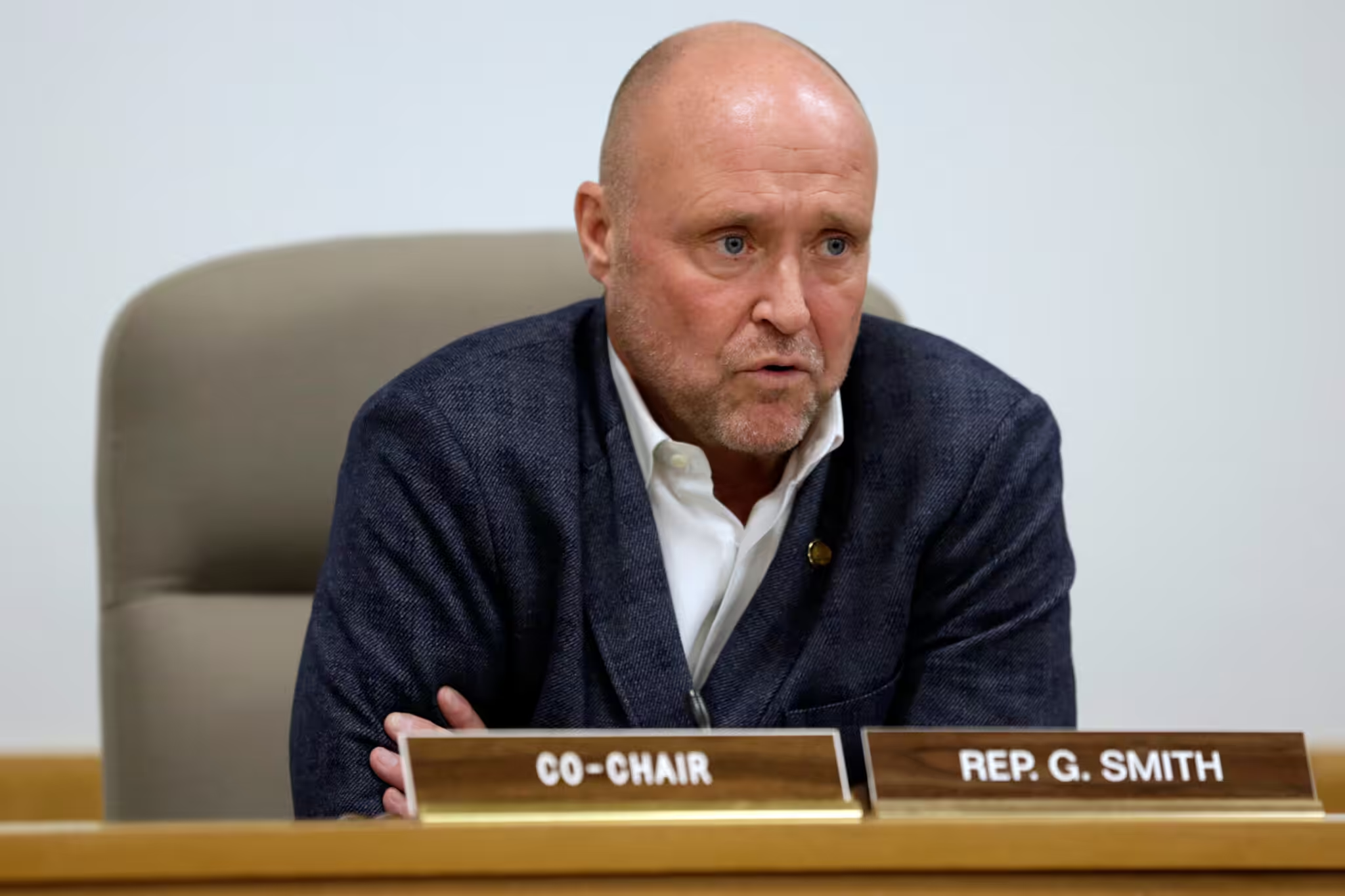
Oregon lawmakers have largely stayed quiet on what consequences, if any, state Rep. Greg Smith should face in the Legislature for violating state ethics laws and running up costs for taxpayers in the tens of thousands of dollars.
Last week, the Oregon Government Ethics Commission fined Smith, R-Heppner, $12,000 for breaking state ethics laws and abusing his role as a public official to boost his own salary and sign off on his own vacation time as director of a federally funded public development authority. The authority’s board ordered him to return $33,000 he received through a raise he arranged without the board’s knowledge, but Smith has held onto the money.
Smith has denied any intentional wrongdoing and says he is willing to give the money back. He agreed to pay the $12,000 fine to close out the case instead of mounting a defense at a contested hearing. The penalty ranks among the largest in state history and reflects the gravity of the conflict-of-interest violations he faced.
The fine came after four investigations into Smith by the commission over the past two years. Two of those investigations found he had failed to disclose clients of his private consulting company on his annual economic interest statements, resulting in letters of education , essentially a formal reprimand. In response to one of the commission’s inquiries, Smith disclosed that his household income had averaged more than $1 million annually in recent years.
The ethics commission was established in the aftermath of President Richard Nixon’s Watergate scandal and is charged with making sure public officials do not use their positions for financial gain or to escape financial harm. The commission can impose civil penalties, but policing the behavior of its own members ultimately falls to the Legislature.
Smith, the longest-serving current lawmaker in the state, has not faced any significant penalties in the Legislature despite the ethics investigations and an ongoing civil lawsuit the state Department of Justice has filed against him and other eastern Oregon officials.
He continues to serve in House Republican leadership and as vice chair of the budget-writing Joint Ways and Means Committee, although House Speaker Julie Fahey, D-Eugene, stripped him of his co-chair role on the General Government budget subcommittee last Friday following the ethics commission’s action. He also retains his seat on the Capitol Construction Committee, a panel where public and private developers pursue state financing for projects.
Smith did not return a call, text or email from the Capital Chronicle, but told Oregon Public Broadcasting that Fahey had recently placed him on a subcommittee that could shape how the state rolls out its Medicaid program after sweeping federal cuts.
“Speaker Fahey made the decision to remove him as Co-chair of the General Government Subcommittee of Joint Ways and Means, but to make no changes to his committee memberships,” Jack Lehman, Fahey’s chief of staff, said in an email to the Capital Chronicle.
In addition to Fahey, Capital Chronicle reporters contacted all 35 Republican members of the Oregon House and Senate, along with their communications staff and the House Republicans’ chief of staff, to ask what consequences Smith should face in light of the ethics commission findings. Reporters also reached out to Rep. Ben Bowman, the House majority leader and a Democrat from Tigard, who declined to comment.
‘Failure to respond’
Reporters asked the lawmakers whether Smith should remain in the Legislature, whether he should keep running for re-election as the Republican nominee for the 57th House District in the November election, whether he should hold onto his spot in House Republican leadership and whether he should continue serving on his committees.
Lawmakers from both parties have been pushed by their colleagues to resign, and have lost committee appointments and leadership positions, over allegations of sexual harassment, for allowing armed intruders into the Capitol, for smoking in the Capitol and for making rude comments.
Last June, after Sen. Chris Gorsek, a Democrat from Troutdale, raised his voice at Rep. Shelly Boshart Davis, a Republican from Albany, during a heated meeting over transportation funding, House Republicans quickly accused him of gender discrimination and harassment. They called for Gorsek to be publicly censured, removed from all committees, required to attend anger management training and the subject of a building-wide notification whenever he was in the Capitol.
Gorsek stepped down from the transportation committee. A bipartisan panel of senators cleared him of engaging in discrimination or harassment, though it found he had been disrespectful. House Republicans said in a news release at the time that his conduct “weakens our democratic institutions,” and criticized Senate President Rob Wagner, a Lake Oswego Democrat, for his “shameful silence, failure to respond and inaction.”
‘Actions have consequences’
Of the 35 members of the Oregon House and Senate Republican caucuses the Capital Chronicle contacted, just three senators and two representatives responded. Reps. Bobby Levy, R-Echo, and Jeff Helfrich, R-Hood River, both declined to comment.
House Minority Leader Lucetta Elmer, R-McMinnville, did not respond to a call, text or email. Sen. Christine Drazan, a Republican from Canby who is running for governor and led the House Republican caucus when it pushed to punish Gorsek, did not respond to multiple calls, emails and a text.
Rep. Dwayne Yunker, R-Grants Pass, did not respond to inquiries but went on Facebook earlier in August to argue that House Republicans need to call on Smith to “take responsibility and do the right thing,” without spelling out what that should look like.
“Leadership sometimes requires difficult conversations with people we respect. Our caucus should have that conversation and ask Rep. Smith to do the right thing,” he wrote. “We cannot demand accountability from others while remaining silent when it is our own. Our principles must mean the same regardless of whose name is involved.”
Sen. Todd Nash, a Republican from Enterprise who also represents voters in Smith’s district, said any decisions about consequences for Smith belong to the House and to voters.
“That’s really a House decision. I’m on the Senate side and I don’t really have input on that,” Nash said. “As far as running for reelection, that’s between Greg and the voters of House District 57 and I respect the voters there and their decision-making, and Greg’s ability to run.”
State Sen. Suzanne Weber, an outgoing Republican from Tillamook, said the commission’s decision shows that “actions have consequences, particularly for those of us entrusted with public office.” Weber is barred from running for re-election after taking part in a six-week walkout in 2023 over Democratic bills on abortion, gender-affirming care and guns.
Like Nash, she said it would be up to voters in Smith’s district to decide whether he should keep representing them.
“I believe all of us who hold public office have an obligation to maintain the public’s trust and to accept the consequences when we fall short of that responsibility,” she said in an email.
Sen. Noah Robinson, a Republican from Cave Junction in southern Oregon, said he found it hard to believe a public official would deliberately and repeatedly violate conflict-of-interest laws and figured Smith must have done so by mistake. He agreed with Nash and Weber that voters should decide Smith’s future in the Legislature.
“I think they (lawmakers) should be held to a high standard. And I think we should give people latitude for mistakes,” he said. “If there’s a pattern of fraud, that’s a different matter.”
The latter question could be settled in the courts in the coming months.
Smith is among several public officials in eastern Oregon being sued by the state for allegedly conspiring to enrich themselves through a deal with Amazon amid data center growth in the region. State attorneys allege Smith helped local officials craft a strategy for concealing their work. He has denied the allegations and any wrongdoing.











Leave a Reply