

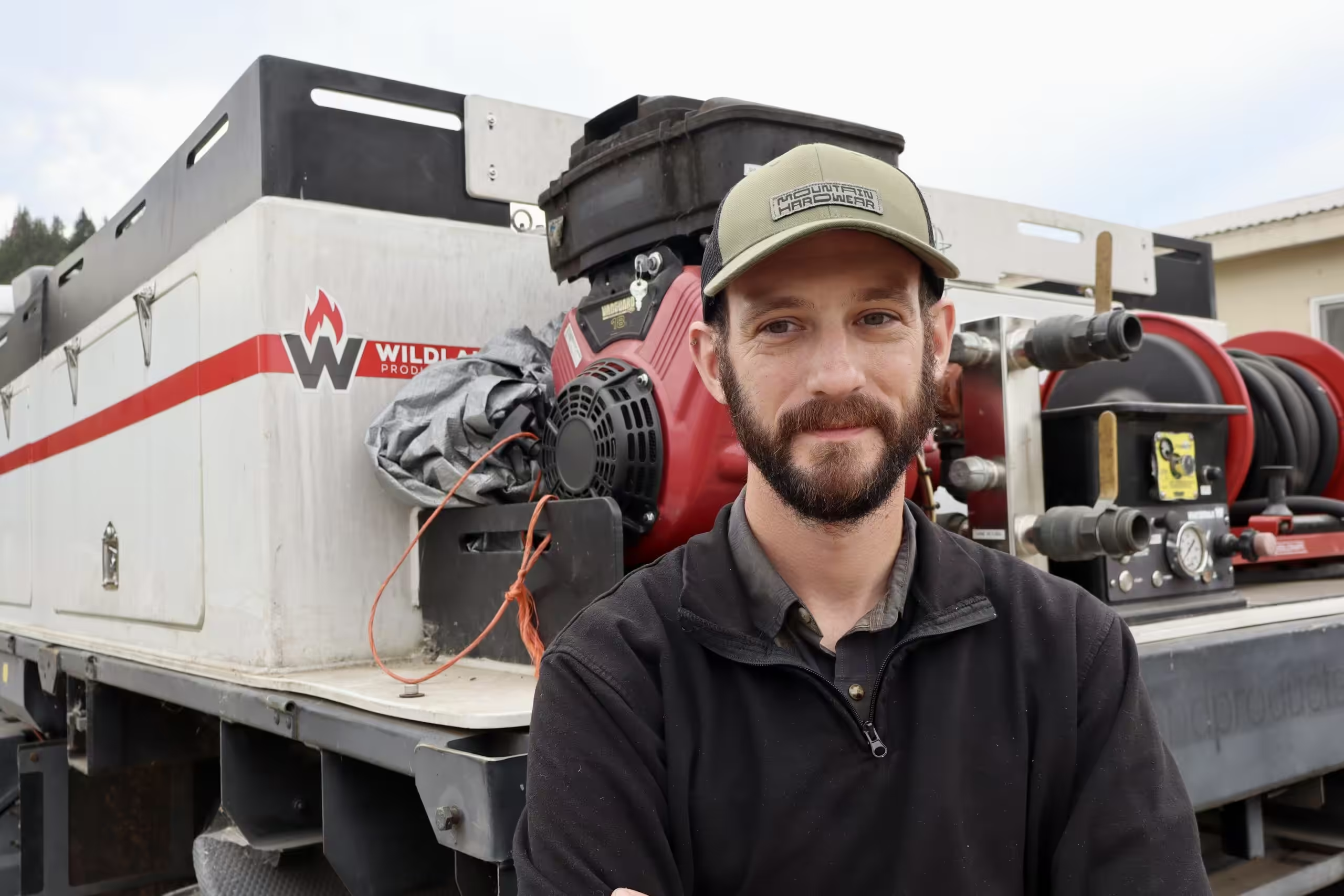
Carson States gripped the wheel of a rumbling rig carrying 500 gallons of water in a sloshing tank.
The engine boss picked his way through sketchy stretches of a rough road in the Mount Hood National Forest, climbing a steep grade while the nearly 93,000-acre Grasshopper Fire burned nearby and crews worked around him.
“Eventually, some of the water tender operators and the larger engines were just, ‘It’s not feasible for us to do this. We can’t get into these roads,'” said States, back home in Lane County on Aug. 21.
Lightning sparked the Grasshopper Fire nearly a month earlier.
On Tuesday, Aug. 18, more than 1,500 firefighters and support personnel braced for a particularly volatile day as strong winds threatened to whip up the flames and low humidity gave them little chance to slow the spread.
That same day, the U.S. Department of Agriculture , which houses the U.S. Forest Service that manages the national forests , announced it had formally filed a proposal to scrap the 2001 Roadless Rule. The regulation prohibits road construction and timber harvesting across roughly 45 million acres of undeveloped national forest land, including about 2 million acres in Oregon.
In a press release carrying a statement from U.S. Department of Agriculture Secretary Brooke Rollins, the department pointed to President Donald Trump’s executive orders aimed at ramping up logging on public lands.
It also cast the policy as an obstacle to wildfire risk reduction work in places such as the 8,000-acre roadless area around Hardesty Mountain, roughly 25 miles from downtown Eugene.
“For too long, outdated restrictions have kept tens of millions of forested acres off-limits to the very treatments that improve forest health and reduce wildfire risk to our communities,” Rollins said.
Many firefighters, including States, and their advocates push back on Rollins’ claim.
Differing views on forest, wildland fire management
States is an independent contractor with 10 seasons of firefighting under his belt. He has worked for federal agencies and alongside the Oregon Department of Forestry. Now working as an independent contractor, he can speak openly about the issues.
Beyond responding to wildfires, he also sets prescribed burns.
Prescribed fire is a tool that introduces proactive, low-intensity burns to prevent trees and shrubs from overcrowding. It promotes native plant growth and lowers the risk of extreme wildfires.
“I’m all for fuel-reduction programs,” States said. “It’s very important to reduce these catastrophic megafires that we are seeing, but there are backcountry crews out there whose sole purpose is to hike into these places and perform that work. The issue is there’s no funding for these programs, and on top of that, we don’t have funding for the existing national forest roads that are out there.”
In a statement released by Eugene-based Firefighters United for Safety, Ethics, and Ecology, States was among five current or retired firefighters who opposed the agriculture department’s proposal.
The organization hosted a conversation Sunday at Art House, where roughly 75 people packed a sold-out auditorium for short films and a panel examining how communities can develop a better relationship with fire.
Tim Ingalsbee, executive director of Firefighters United for Safety, Ethics, and Ecology, believes the Trump administration’s real focus is timber, and that the agriculture department’s messaging about wildfire reduction and firefighter access is misleading.
“Not in our name,” Ingalsbee said during the event.
“From the perspective of wildland firefighters, this (repeal of the roadless rule) is not going to make it safer, more efficient to go suppress wildfires. It’s going to be just the opposite. It’s going to increase their burdens, risk, and hazards. “
Ingalsbee’s advocacy group has tracked the agriculture department closely since it announced its intent last year to repeal the rule. The department opened a brief window for public comment.
An analysis of those comments by the Center for Western Priorities found 99.2% of submissions to the Federal Register backed keeping the rule in place. Despite the public opposition, the department pushed ahead with deregulation, and its proposal landed in the Federal Register Aug. 20. In its reasoning, the department stated:
“The 2001 Roadless Rule limited the Forest Service’s ability to conduct vegetation management within inventoried roadless areas and has contributed to the lack of active management of the national forests, which in turn has contributed to challenges in addressing forest health concerns.”
The phrase “forest health” carries different meanings. Members of the Agriculture Department and the timber industry interpret it one way; environmental groups and some academics see it differently.
The American Forest Resource Council, an industry group that supports the repeal, frequently points to thinning trees and an open forest floor as markers of healthy conditions. Such thinned forests, the group argues, lower the risk of extreme wildfire.
Environmental groups, however, often highlight complex, old-growth forests that have adapted to fire in areas largely untouched by humans.
Research vs. rationale
Research by the U.S. Forest Service has shown that while roads may provide access to fires, they also serve as the source of high rates of human-caused ignition.
A draft of the agriculture department’s environmental impact statement, an assessment legally required for significant rule changes, acknowledged that point.
The 333-page impact statement weighs three alternatives: no action; repeal; and modification for more flexibility within the existing rule. In a table comparing the alternatives, it stated:
“Currently, the number, frequency, and density of wildfire ignitions are lower in designated wilderness and potentially affected IRAs (inventoried roadless areas) compared to other NFS (National Forest System) lands. Under alternatives 2 and 3, if there is an increase in public road access, there could be (an) increase (in) the number and frequency of wildfires as human-ignitions are more likely near roads. However, public access could be limited to minimize fire hazard in high-risk areas.”
The document also said:
“Agency management records show that a lack of roads has not prevented fire prevention or protection measures, especially wildland fire use and prescribed fire. However, road restrictions limit opportunities for mechanical thinning and fire control.”
Throughout the document, the federal government repeatedly cites wildfire risk reduction as a justification for rolling back the roadless rule. In its conclusion, it said:
“Alternative 2 (a repeal) enhances the quality of life for people that value timber harvest and potential mineral and energy development and the economic contributions that these provide to the community. Both action alternatives would similarly enhance the quality of life for people living in communities near the IRAs (inventoried roadless areas), as there are increased opportunities for wildfire risk mitigation.”
Based on States’ experience, he believes any mitigation will be undercut by the greater number of wildfires that will start.
He also called pushing new roads “irresponsible” for firefighter safety. Crews already labor in harsh conditions for long hours and are expected to rely on roads that aren’t being maintained.
Up at 5 a.m. one day on the Grasshopper Fire, States headed to a morning briefing after a quick breakfast. During announcements, officials urged firefighters to be careful with their heavy equipment on the roads.
“I thought that was pretty telling,” he said. “Their resource advisors were specifically requesting, ‘Please don’t hurt our roads, because we don’t have the money to upkeep it.'”







Leave a Reply