

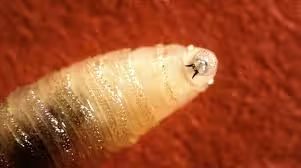
The U.S. Department of Agriculture confirmed Wednesday that the New World screwworm fly has been detected in south Texas — marking only the third time the flesh-eating parasite has surfaced in the country in decades and the first time it has posed a direct threat to the nation’s cattle industry in as long.
Agriculture Secretary Brooke Rollins identified the case as a 3-week-old calf in LaPryor, Texas, roughly 50 miles (80 kilometers) from the Mexico border. Texas State Veterinarian Bud Dinges said he has established a 12-mile (20-kilometer) quarantine zone, barring the movement of any warm-blooded animal — pets included — from the area without prior inspection.
Rollins said no additional detections have been recorded elsewhere in the U.S., and officials were quick to clarify that while the fly’s larvae pose a serious threat to livestock, they do not affect food supplies. With proper treatment, even the infested calf is expected to fully recover, she said.
Rollins, along with U.S. and Texas agriculture officials and cattle industry leaders, has been raising public alarms about the fly’s spread through Mexico for more than a year — driven by the memory of the parasite causing tens of millions of dollars in losses, potentially worth billions in today’s dollars, before its eradication in the 1970s.
It is the first confirmed case in Texas since 1966, Rollins said.
Months of preventive efforts have included dropping millions of sterile screwworm flies into the area to mate with wild females — the same strategy that successfully preceded the fly’s earlier eradication. Rollins said the USDA is confident enough in those preparations to assert “there is no threat of mass infestation.”
“There is no reason to believe this incursion will result in establishment of the pest in our country,” Rollins said.
The announcement came just one day after Rollins held an online news conference to underscore how close the threat had grown — with confirmed cases in Mexico as near as 25 miles (40 kilometers) from the border — and to detail the USDA’s efforts to combat it.
The New World screwworm fly is a tropical species that once infested cattle across the warm-weather regions of the southern United States before being pushed back and contained in Panama, where it remained until late 2024.
The female fly deposits its eggs in open wounds or mucous membranes, where they hatch into flesh-eating larvae — a trait that sets them apart from most fly species. The larvae can infest livestock, wild mammals, household pets and even humans, and untreated infestations can prove fatal.
In August 2025, federal health officials confirmed a case in a Maryland resident who had traveled to El Salvador. The victim recovered, and officials found no evidence of further transmission. Before that, the last known outbreak occurred in the Florida Keys in September 2016, primarily among wild deer, and was contained early the following year without spreading.
Female screwworm flies mate only once during their months-long lives. If that mating occurs with a sterile fly, the eggs will not hatch — and the population gradually dies out. Past eradication campaigns proved so effective that the U.S. eventually shut down its sterile fly breeding facilities, leaving only one operational site, in Panama, for decades.
That is now changing. The USDA committed $21 million to convert a fruit-fly breeding facility in southern Mexico into a screwworm breeding site, opened a new dispersal center for sterile flies in southern Texas and broke ground on a $750 million screwworm fly factory in the same region. The Mexico breeding facility is expected to be operational next month, Rollins said.
Officials also deployed 8,000 fly traps along the U.S.-Mexico border, and Rollins said the USDA has tested more than 58,000 fly samples along with 19,000 wild animals.
Rollins also shut the U.S.-Mexico border to livestock imports from Mexico last year — a decision she defended during Tuesday’s news conference. Officials noted the fly can also travel with people, their pets and wild animals, though Rollins stressed Wednesday evening that it does not cover great distances on its own.
Dinges urged ranchers and pet owners to take the quarantine zone seriously.
“Please help us prevent any further movement of this pest by staying put,” he said.










Leave a Reply