

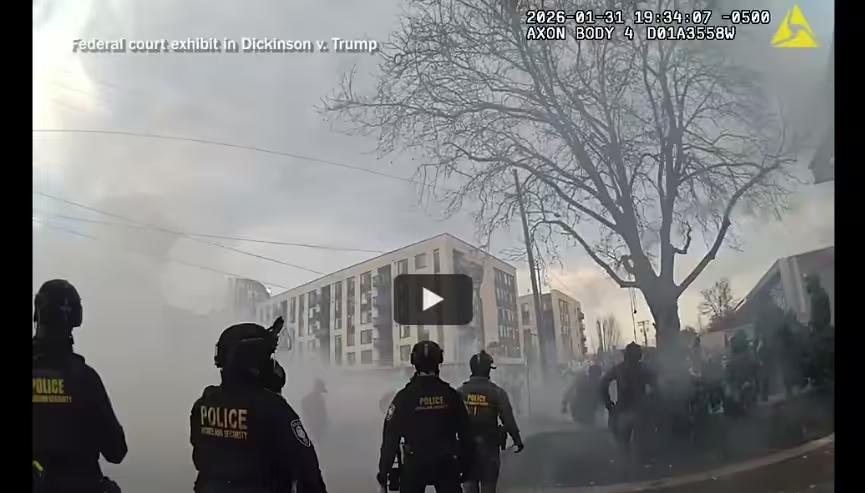
A federal appeals court is set to review controversial restrictions on the use of force by federal officers during protests outside an immigration facility in Portland, Oregon, marking a significant legal battle over crowd control tactics and First Amendment rights.
Appeals Court to Weigh Limits on Tear Gas, Munitions
A three-judge panel from the 9th U.S. Circuit Court of Appeals will hear arguments Tuesday on whether to uphold or block two lower court orders that limit the use of tear gas and other crowd-control munitions near the U.S. Immigration and Customs Enforcement building in Portland.
The court has allocated 20 minutes for each case, both of which stem from legal challenges to federal law enforcement tactics during protests.
Key Court Orders Under Review
One ruling, issued March 6 by U.S. District Judge Amy Baggio, restricts federal agents from deploying chemical agents in amounts that could drift into nearby residential areas, including the Gray’s Landing apartment complex.
A second order, issued March 9 by U.S. District Judge Michael H. Simon, prohibits the indiscriminate use of force against peaceful protesters and freelance journalists gathered outside the ICE facility.
Both injunctions were temporarily paused last month while the federal government pursues appeals.
Federal Government Pushes Back
Attorneys for the U.S. Department of Justice argue the restrictions are overly broad and could compromise public safety and law enforcement operations.
Government lawyers contend that the rulings would make it difficult for officers to respond to violent or unlawful demonstrations, while also infringing on executive authority.
In court filings, DOJ attorney Brenna H. Scully criticized one order as impractical, stating it forces officers to predict how environmental factors like wind could spread chemical agents.
Protesters Cite Free Speech Concerns
Attorneys representing protesters and journalists argue the restrictions are necessary to prevent excessive force and protect constitutional rights, particularly under the First Amendment.
They claim federal officers have used crowd-control measures, including pepper spray and projectile munitions, in ways that suppress nonviolent demonstrations.
Legal filings also allege a lack of proper training among officers and point to no disciplinary actions taken for past use-of-force violations.
State, Advocacy Groups Join Legal Battle
The American Civil Liberties Union is involved in similar litigation and helped shape the Portland case with a more narrowly focused injunction.
Meanwhile, the state of Oregon has filed a friend-of-the-court brief, emphasizing its interest in ensuring that law enforcement respects the rights and safety of residents.
Related Ruling in Los Angeles
The hearing follows a recent decision by the same appellate court in a Los Angeles protest case, where judges upheld most restrictions on federal force but ordered the lower court to narrow the scope of its injunction.
Ongoing Tensions at Portland ICE Facility
Although the injunctions remain on hold, recent protests outside the Portland ICE building have continued. During a March 28 demonstration, no chemical agents were deployed, but local and state police intervened to disperse crowds.
Authorities reported multiple arrests after protesters allegedly blocked entrances, damaged property, and threw objects at officers.
What’s Next
The appellate hearing is scheduled for 10 a.m. in San Francisco, with proceedings available via livestream on the court’s official website.
Key Takeaways:
- Appeals court reviewing limits on federal use of force in Portland ICE protests
- Legal battle centers on tear gas, munitions, and First Amendment rights
- DOJ argues restrictions hinder law enforcement operations
- Protesters claim measures are needed to prevent excessive force
- Decision could shape future protest policing policies nationwide
The outcome of the case could have far-reaching implications for how federal agencies manage protests and balance public safety with constitutional protections.





Leave a Reply