

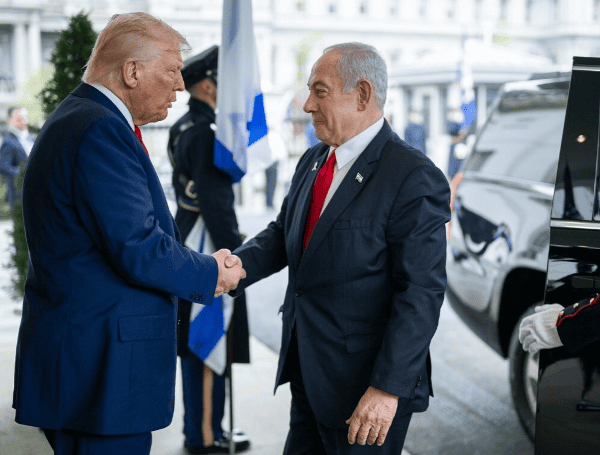
For decades, billions of American tax dollars have quietly flowed into Israel’s military budget each year, cementing one of Washington’s most enduring foreign policy traditions. President Donald Trump now seeks to fundamentally restructure that arrangement.
Beginning in 2027, the United States will discontinue its annual $4 billion aid package to Israel, Trump announced Tuesday on Fox News Channel. In its place, he proposed transitioning Washington’s closest Middle Eastern ally into a paying customer for American-made weapons and defense equipment.
Notably, Trump maintains that the proposal did not originate within the White House. According to the president, Israeli Prime Minister Benjamin Netanyahu personally introduced the concept, initiating a private, multi-year dialogue between the two leaders regarding a fundamental reshaping of their defense relationship.
“You can consider it barter. You can consider military aid or cash,” Trump stated. “Look, we give them $4 billion of things and money, and they don’t need it. And I was approached by Bibi Netanyahu, and we’ve been talking about it for a couple of years because it’s a lot of money.”
Netanyahu’s office did not issue an immediate public response to Trump’s remarks.
The proposed restructuring emerges against a backdrop of significant domestic political tension surrounding U.S. foreign spending. Trump argued that Israel’s economy is sufficiently robust that it no longer requires direct American financial support, while simultaneously acknowledging growing pressure on the issue domestically. The billions directed overseas, Trump noted, have become a prominent political target for progressive Democrats, specifically citing Michigan Senate candidate Abdul El-Sayed.
Over recent years, Washington has directed tens of billions of dollars in military assistance to Israel. Should Trump’s plan advance, 2027 could represent the end of grant-based funding , replacing decades of direct subsidies with commercial defense contracts and straightforward arms sales.
The foundation of current U.S. assistance rests on a landmark 10-year Memorandum of Understanding signed during the Obama administration in 2016, which committed approximately $3.8 billion annually in military financing through 2028.
Although Israeli defense officials have periodically raised the possibility of gradually reducing the nation’s dependence on direct American subsidies, moving ahead of the 2028 expiration date would require formal renegotiation and broad congressional approval. Any abrupt transition to an arms-sales-only framework also risks significant opposition on Capitol Hill, where bipartisan support for baseline Israeli defense funding has long served as a cornerstone of American diplomatic strategy throughout the Middle East.






Leave a Reply