

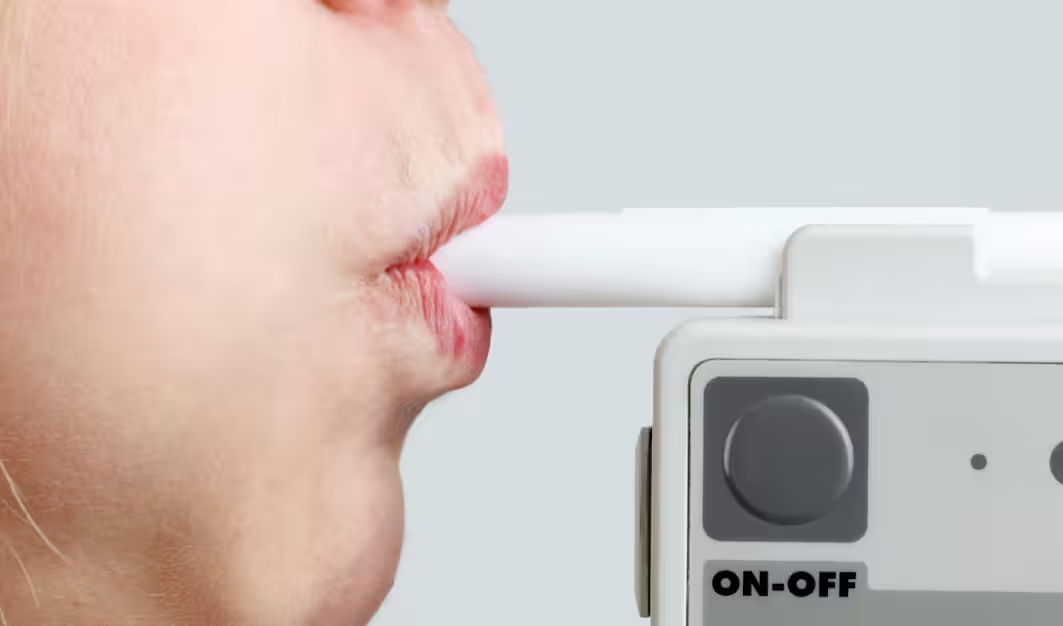
A team of researchers at Virginia Commonwealth University has developed a prototype device that could revolutionize how law enforcement detects marijuana use on the road.
The experimental THC breathalyzer is compact, affordable, and designed to function without the need for laboratory analysis—something that has long limited existing cannabis detection tools.
How the 3D-Printed Device Works
Led by forensic science expert Emanuele Alves, the device resembles an asthma inhaler and is built using 3D-printed components. It includes three main parts: a mouthpiece to capture breath, a cartridge for chemical reactions, and a chamber that displays results.
When a person exhales into the device, airborne cannabinoid particles interact with a mixture containing a special dye. If delta-9 THC is present, the solution changes color—typically turning a dark red—indicating recent cannabis exposure.
Researchers say the device can detect cannabinoid levels between 10 and 100 nanograms and can differentiate between compounds such as THC, CBD, and CBN using color-based analysis.
Why This Matters for Law Enforcement
As cannabis legalization expands across the United States, authorities are seeking reliable ways to detect impaired driving. While alcohol impairment can be easily measured using traditional breathalyzers, marijuana testing remains far more complex.
Currently, most THC detection methods rely on lab-based analysis, which can take 24 to 48 hours—or even longer with confirmation testing. This delay makes real-time roadside enforcement difficult.
The new device aims to bridge that gap by offering immediate, on-the-spot results, potentially acting as a deterrent similar to alcohol breath testing.
Scientific Challenges Still Remain
Despite the promise of this technology, experts caution that detecting THC does not necessarily prove impairment. Unlike alcohol, cannabis affects individuals differently depending on tolerance, frequency of use, and metabolism.
Research from the National Institute of Standards and Technology has questioned whether THC levels alone can reliably indicate recent use or impairment. Similarly, the National Highway Traffic Safety Administration has noted limited evidence linking THC concentration directly to crash risk.
Studies suggest that frequent users may have higher baseline THC levels without being impaired, while occasional users may experience stronger effects at lower concentrations.
What’s Next for the THC Breathalyzer?
The research team has filed a patent for the device, but additional testing is required before it can be widely used. Future efforts will focus on improving accuracy, ensuring it distinguishes THC from other substances, and validating its performance in real-world conditions.
Meanwhile, policymakers continue to push for standardized tools to measure marijuana impairment, highlighting the growing need for reliable roadside testing solutions.


Leave a Reply